Fresh Air and Forward Motion:
Why Getting Outside Changes Everything After 60
Fresh Air and Forward Motion: Discover why leaving the house regularly is one of the most powerful things seniors can do for their health, mood, and sense of purpose — and how to rebuild the habit gently, one outing at a time.
Fresh Air and Forward Motion
There is a particular kind of stillness that settles over a life when the routine of work disappears. For some people it feels like freedom. For others, after the initial relief fades, it begins to feel like something else entirely.
I noticed it in myself after my health setback. The days had a different texture when there was nowhere I needed to be. And without quite realising it, the radius of my world began to shrink. The front door started to feel like more of an effort than it used to.
If this sounds familiar, I want to say something clearly: this is not weakness, and it is not laziness. It is what happens to most of us when the external structure of life is removed. The house becomes comfortable. The world outside feels like it requires more energy than we currently have.
But here is what I have come to understand — the house is not resting you. It is slowly contracting your world.
Why leaving the house matters more than you think
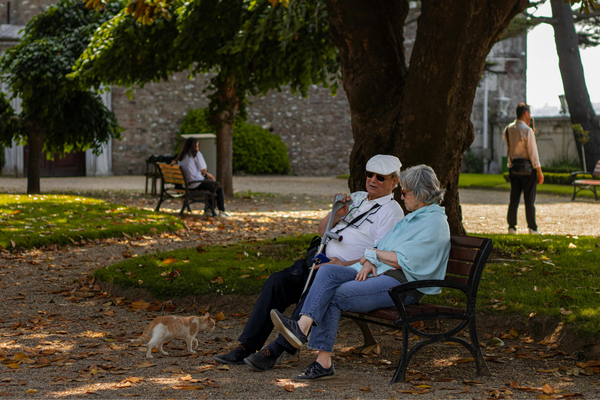
The research on this is remarkably consistent. Older adults who leave the house regularly — for any reason, not just exercise — have lower rates of depression, better cognitive function, stronger immune response, and a measurably greater sense of purpose and wellbeing than those who don't.
This isn't just about fresh air, though that helps. It's about the small but constant stimulation that comes from being in the world. A different view. An unexpected conversation. The weather on your face. The simple act of having somewhere to go.
When we stay indoors for extended periods, the brain receives fewer of the varied inputs it needs to stay engaged and alert. The body stiffens without the gentle challenge of uneven pavements, kerbs, and the small physical negotiations of moving through a real environment.
Getting out of the house is, in its quiet way, one of the most powerful things you can do for yourself.
How often, and for how long?
The most commonly recommended baseline is to leave the house at least three times a week — more if you live alone. This doesn't mean long excursions or demanding activities. An hour is enough to make a difference, physically and psychologically.
What matters more than duration is variety. Errands and appointments are necessary, but they cannot be the whole of your outings. Running to the chemist and back is not the same as meeting a friend for a cup of tea, even if both technically involve leaving the house.
Try to ensure that at least once or twice a week, you are going somewhere for the sole purpose of human connection or simple enjoyment — not to accomplish a task.
The Social Dimension

This is where I want to be direct, because it's the part most of us are quietly resistant to.
Social connection is not a luxury. For older adults, chronic loneliness carries health risks comparable to smoking fifteen cigarettes a day — that is not a metaphor, it is what the research shows. Regular social interaction supports immunity, mental acuity, emotional resilience, and even cardiovascular health.
The good news is that the bar for beneficial social interaction is lower than most people expect. You don't need a large social circle or a packed diary. A regular conversation with someone you know — a walking companion, a weekly class, a book group, a neighbour you stop to chat with — is genuinely enough to make a difference.
If your social connections have thinned over the years — as they do for many of us, through retirement, bereavement, or simply the drifting that happens in later life — please don't be discouraged. Building new connections after sixty is entirely possible. Libraries, community centres, walking groups, local churches, and adult learning classes are full of people in exactly the same position.
The first step is always the hardest. But it is also, without exception, worth taking.
A Gentle Starting Point
Fresh Air and Forward Motion
If getting out of the house has begun to feel like an effort, I'd suggest starting very small. Not three outings a week — just one deliberate, non-essential outing this week. Somewhere you choose to go, rather than somewhere you have to be.
A walk to a local café. A stroll through a park. A visit to the library.
Notice how you feel when you return home. In almost every case, the world inside looks a little better for having briefly left it.
That is always where it begins.

Jasper Wildwood | JasperWildwood.com
Strength Returns, One Step at a Time.
This is Part 1 of the Staying Young at Heart series.
Next: Try Something New — why novelty is one of the best things you can do for an ageing brain.