Volunteer With Young People.
Volunteer With Young People. The final article in the series, and in some ways the most surprising. Research increasingly suggests that regular contact with younger people has measurable health benefits for older adults. This article looks at why — and at the many practical ways to make it part of your life.
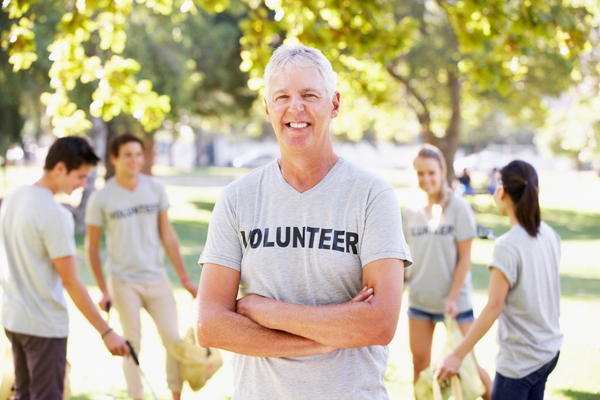
I want to close this series with something that surprised me when I first came across it — and that has stayed with me since.
There is a growing body of research suggesting that regular contact with younger people has a measurably positive effect on the health and wellbeing of older adults. Not just psychologically, though the psychological benefits are significant. But physiologically — in ways that show up in reduced inflammation markers, improved cognitive function, and even changes in the way the body ages at a cellular level.
Researchers are not entirely sure why. The leading theories involve a combination of factors: the increased stimulation and energy of younger environments, the sense of purpose and relevance that comes from being needed by someone younger, and the simple, irreplaceable effect of feeling genuinely useful to the world.
Whatever the mechanism, the conclusion is consistent: spending regular time with young people — particularly in a role where you are contributing something — is one of the most powerful things an older adult can do for their own wellbeing.
On volunteering
I am a strong believer in voluntary contribution at any age. But I want to be clear about why I'm recommending it here, because I think the usual framing — "it's good to give back" — undersells something important.
Volunteering with young people is not a selfless act at the expense of your own time and energy. It is, when done in the right context and the right spirit, one of the most genuinely rewarding and personally enriching things available to us in later life. The giving and the receiving are far more balanced than the word "volunteer" sometimes implies.
With that said — what does it actually look like?
What's available?
Tutoring is perhaps the most obvious starting point. Every school and community centre has children and young people who are behind in their studies and who would benefit enormously from the patient, undivided attention of an experienced adult. You do not need a teaching background. You need to be reasonably comfortable with a subject, willing to listen, and patient. Background checks are standard and straightforward.
Mentoring is a step further. Organisations like the Mentoring Alliance, or local equivalents in your area, match older adults with young people — particularly those without strong adult role models — for regular one-to-one contact over months or years. The research on the impact of these relationships, for both parties, is remarkable.
Sports and activities are another avenue. Youth sports clubs — football, cricket, athletics, swimming — depend heavily on volunteers for coaching, officiating, and organisation. You do not need to be a former athlete. Administrative support, logistics, and simply showing up reliably are all genuinely valuable.
Schools themselves are consistently grateful for adult volunteers. Reading programmes, library help, after-school activities, and assisting with school events are all areas where an experienced, willing adult is welcomed. If you have grandchildren in local schools, this is a particularly natural starting point.
Arts and cultural organisations — youth theatres, music groups, local museums with young visitor programmes — are another option, particularly if your background or interests are in creative areas.
And then there are children's hospitals, hospices for young people, and youth-focused charities of every description — all of them sustained in large part by the quiet, consistent effort of volunteers who simply decided to show up.
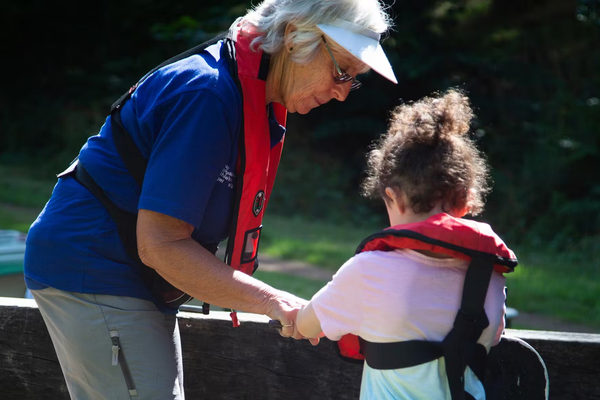
Or like this volunteer with The Canal And River Trust, (CRT). Through local teams of trained and enthusiastic volunteers, they host school and group visits to the waterside, broadening learning through hands-on activities, workshops and events.
On the energy exchange
I want to end with something that is harder to quantify but that I think is deeply true.
There is an energy that comes from being around young people that is difficult to describe without sounding mystical, which I don't intend. It is simply the energy of people who are still in the early chapters — who are still becoming, still discovering, still forming their sense of what is possible.
Being around that does something. It reminds us that the world is still being made. That the story is still going. That there is still something worth contributing to.
That reminder, in later life, is not a small thing.
Jasper Wildwood | JasperWildwood.com
Strength Returns, One Step at a Time.
This is the final article in the Staying Young at Heart series. I hope it has been useful, and that something in it has pointed you toward something you want to try — or try again.